Introducing the AI Safeguards Series: One Failure Mechanism, Twenty-Three Rooms
Over the coming weeks, esmaelnexusx.com is publishing a 24-article series on AI safeguards and their strategic implementation — sector by sector, from security operations and identity to healthcare, finance, energy, manufacturing, education, the public sector, and the supply chain, closing with a cross-sector capstone and a companion research working paper.
This introduction explains what the series is, what it deliberately is not, and the single argument that runs through all of it.
What This Series Is Not
It is not a tooling guide. You will find no vendor comparisons, no prompt engineering, no deployment tutorials. The internet has those in industrial quantities, and they answer a question this series considers secondary: how do I make the AI work?
The question here is the one that determines whether the working AI becomes an asset or a liability: how does an organization stay in charge of what its AI is actually deciding?
The Argument
Read enough AI incidents across enough industries and the surface details stop mattering. A hallucinated citation filed in court, a drifted setpoint in a plant, a biased screener in a hiring funnel, a risk score that quietly became a caseload decision — different sectors, different regulators, different vocabularies. Same mechanism underneath:
- The AI enters as advisory. Honestly classified, at the moment of classification — a recommender, a triage aid, an optimizer. The label exempts it from the governance that "decisions" would attract.
- Authority accretes. Under throughput pressure, human review thins into ratification, ratification into habit, habit into architecture. Each step is small, locally rational, and undocumented. No meeting ever convened to transfer authority, so no governance trigger ever fired.
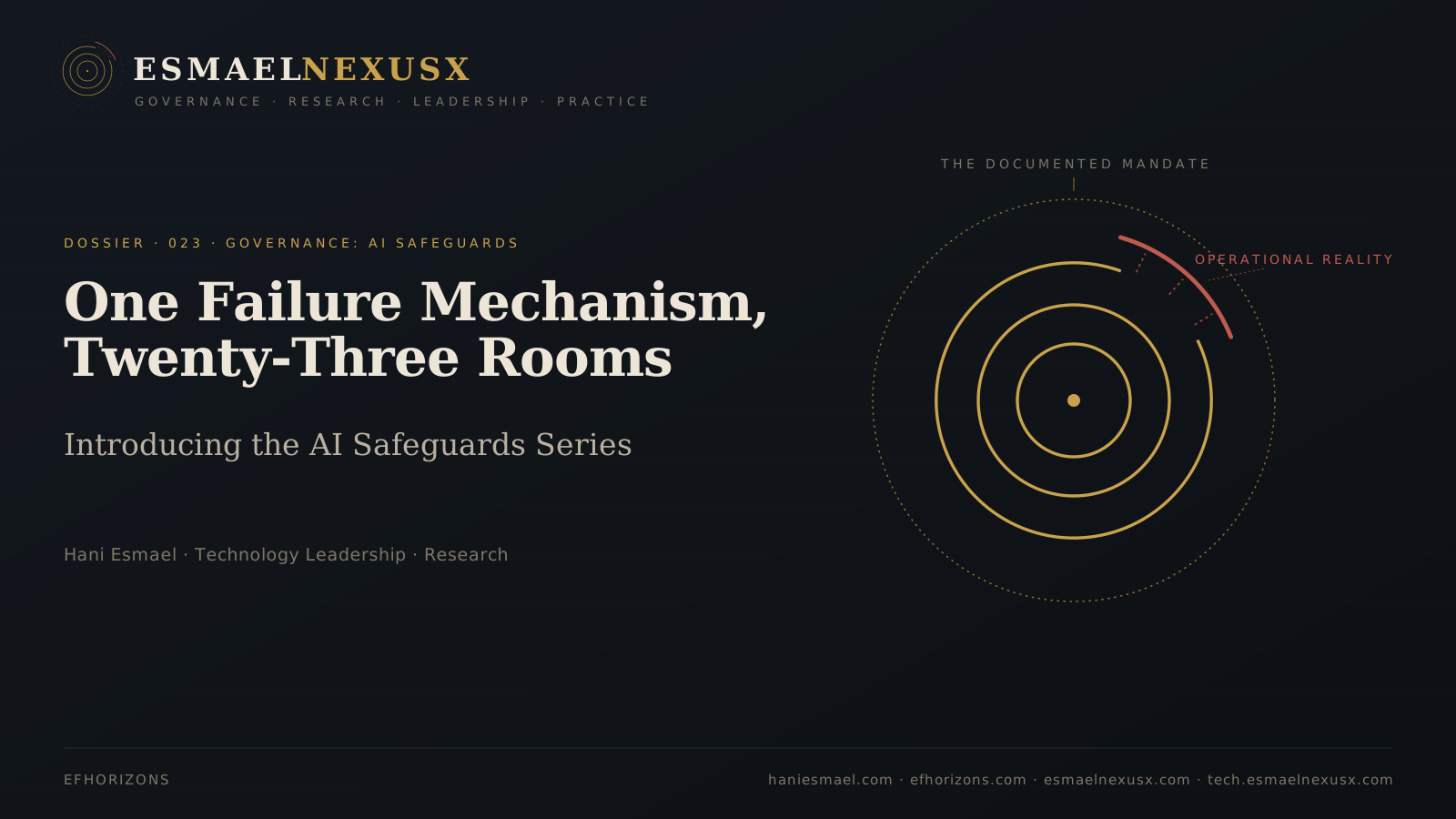
- The threshold. The gap between the documented mandate and the operational reality crosses a line where it can no longer be unwound quietly. An incident, audit, or lawsuit reveals what the systems had been deciding all along — a surprise to the paper, never to the practitioners.
The Structure of Every Article
Each piece runs the same spine, because the discipline is the point:
- The mandate on paper — what the governance documents claim.
- The operational reality — what the floor actually does, and why the divergence is systematic rather than sloppy.
- A named safeguard framework — three enforcement points you can implement and audit.
- Leadership vs. practitioner — what each sees, why the gap persists, and the metric or channel that bridges it.
- The research lens — an empirical method, usually borrowed from an older discipline, that converts "we trust it" into "we measured it."
- Path forward — five actions, in order.
Why the Academic Splash
Every article leans on established research — institutional decoupling, organizational silence, principal-agent theory, normal accident theory, signal detection, Goodhart's law — not for decoration, but because AI governance keeps rediscovering problems organizational science solved the vocabulary for decades ago. Practitioners who know the literature debug their organizations faster.
The capstone article formalizes the cross-sector pattern into a falsifiable claim, and the companion working paper develops it in full academic form, with testable propositions any organization can run against its own incident history.
Reading Paths
- Executives and boards: start with the capstone (#24), then Governance Boards (#19) and Regulatory Strategy (#22).
- Security leadership: #1 (SOC), #2 (IAM), #18 (Incident Response), #21 (Red-Teaming).
- Sector specialists: go straight to your industry's article; the framework travels.
- Researchers: the capstone and the working paper, which carries the propositions and methodology.
Welcome to the series.

0 Comments
Leave a comment