About the Author
Hani Esmael is a cybersecurity practitioner focused on the intersection of security operations, governance, technology leadership, and applied research.
His work explores how organizations can bridge the gap between cybersecurity theory and operational reality, particularly in areas involving security governance, identity management, artificial intelligence, and technology transformation.
Through EsmaelNexusX, he writes practitioner-focused analysis examining not only how security technologies work, but how organizations successfully adopt, govern, and sustain them.
His perspective is shaped by experience across software engineering, enterprise technology, cybersecurity operations, and digital transformation initiatives.
The SOC That Trusts Its Machines: AI Safeguards in Security Operations
Governance, Accountability, and the Future of Human Judgment in AI-Assisted Security Operations
Executive Summary
Artificial intelligence has become a permanent resident inside the modern Security Operations Center.
It analyzes events, enriches alerts, correlates indicators, summarizes incidents, recommends response actions, Increasingly, it is also making decisions.
Not the version of autonomous decision-making that captures headlines. The reality is far more consequential, A security analyst decides whether an alert deserves attention. An AI system ranks that alert lower, and an analyst never sees it as a result a detection rule fires.
An AI system determines it matches a known benign pattern, then the alert closes. a response workflow triggers,
A system isolates an endpoint before a human ever reviews the evidence.
Each individual decision may appear reasonable.
The organizational risk emerges from accumulation.
The question facing modern security leadership is no longer whether AI belongs in the SOC. That debate has mostly ended.
The question is:
The industry has spent years discussing AI capability.How do we ensure that increasing machine authority does not quietly exceed our ability to govern it?
Far less attention has been given to AI accountability.
Organizations carefully evaluate model accuracy, vendor capabilities, and operational efficiency. Yet many struggle to answer a basic governance question:
When an AI system makes the wrong security decision, who is responsible?
The answer cannot simply be "the analyst."
That answer may satisfy a policy document, but it does not reflect operational reality.
A human cannot meaningfully supervise thousands of automated decisions occurring faster than human review cycles allow. A checkbox labeled "human-in-the-loop" does not create oversight. Oversight requires authority, visibility, measurement, and the ability to intervene.
This paper explores the governance gap emerging inside AI-assisted security operations.
The argument is simple:
The greatest risk of AI in the SOC is not that machines will replace humans. It is that organizations will gradually surrender judgment without realizing they have done so.
The solution is not rejecting automation.
Security operations cannot scale without automation.
The solution is building trustworthy automation through three control principles:
Detect → Decide → Defend
- Detect: Ensure the information feeding AI systems remains reliable, current, and measurable.
- Decide: Define which decisions AI may make, which require human approval, and which should never be automated.
- Defend: Maintain accountability through auditability, reconstruction, and continuous validation.
A SOC should not be judged by how much automation it deploys.
It should be judged by whether it understands what that automation is allowed to do.
Opening Reflection
There is a familiar conversation happening in security leadership meetings around the world.
The discussion usually begins with a problem.
The SOC has too many alerts.
Analysts are overwhelmed.
Response times are increasing.
Security teams cannot continue scaling by simply adding more people.
The conclusion appears obvious:
And that conclusion is correct; The modern threat environment has outgrown purely manual security operations. Attackers automate reconnaissance, exploitation, credential abuse, and persistence. Defenders cannot respond to automated threats with entirely manual processes.We need more automation.
Automation is not optional anymore. But there is a subtle transition that occurs after automation is introduced. At first, automation assists human judgment then a tool enriches an alert, a model suggests a priority, a workflow recommends an action, the analyst remains the decision maker, over time, however, the relationship can change. the analyst begins trusting the recommendation, the recommendation becomes the default, the exception becomes the investigation, eventually, the question changes.
Instead of asking:
The organization starts asking:"Should we trust this AI decision?"
That is a fundamentally different operating model."Why did someone override this AI decision?"
And it usually happens without a single meeting, approval, or announcement.
No executive says:
"From this day forward, the machine will decide which security events matter."
The transition happens through small operational choices.
A busy shift.
A loaded alert source.
A temporary suppression rule.
A workflow created to reduce workload.
A dashboard celebrating improved closure rates.
Each decision appears rational.
Together, they create a new reality.
Introduction
Cybersecurity has always existed in the tension between human judgment and technical systems.
Firewalls enforce policies, but humans define those policies.
Detection platforms identify suspicious activity, but analysts interpret context.
Security tools provide signals, but people decide what those signals mean.
Artificial intelligence changes this relationship because it does not simply provide information.
It interprets, prioritizes, recommends, and sometimes it acts.
That difference matters; A traditional security tool generally operates according to explicit instructions.
A firewall blocks traffic based on defined rules.
An access control system grants permissions based on configured policies.
A vulnerability scanner compares systems against known conditions.
AI-based systems operate differently.
They infer, estimate, rank, make decisions based on patterns rather than only predefined logic, the capability creates tremendous value.
It also introduces a new category of operational risk.
A traditional system failure is often visible.
A failed firewall rule produces an obvious result.
A broken log collector stops sending data.
A malfunctioning endpoint agent generates errors.
AI failures are frequently more silent.
The system continues operating.
The dashboard remains green.
The automation percentage improves.
The metrics look better.
The problem is that the system may slowly become wrong.
And confidence does not necessarily decrease when accuracy does.
In fact, the most dangerous AI failures are often not obvious failures.
They are successful executions of incorrect assumptions.
Why This Conversation Matters
The cybersecurity industry has historically been very good at discussing technology.
We discuss:
- Detection capabilities
- Machine learning models
- Large language models
- Security automation platforms
- Extended detection and response (XDR)
- Security orchestration and automation response (SOAR)
But cybersecurity incidents rarely occur because an organization lacked a product.
More often, incidents occur because organizations failed to understand the relationship between technology, people, and decision-making.
The same pattern appears repeatedly:
A control existed, process existed, policy existed.
But reality diverged from intention.
This is not a new problem created by artificial intelligence.
AI simply makes the consequences faster and less visible.
Research Lens
One of the oldest lessons in organizational research is that formal structures and operational behavior often drift apart.
Organizations create policies to establish expected behavior. Employees, however, operate within real environments shaped by workload, incentives, deadlines, and practical constraints.
The difference between what an organization says it does and what it actually does has been studied for decades.
Artificial intelligence introduces a new dimension to this old problem: organizations can now create distance between decision-making and human awareness.
AI Has Already Entered the SOC
The discussion around AI in security sometimes focuses too heavily on the future.
Autonomous SOCs, AI security analysts, Fully automated incident response.
Those conversations are interesting, but they can distract from what is already happening today, AI is already influencing security decisions.
Consider common examples:
A SIEM platform assigns risk scores using machine learning.
An XDR platform determines whether behavior is malicious.
A threat intelligence engine recommends whether an indicator is trustworthy.
A security copilot summarizes an investigation.
A SOAR workflow automatically performs containment actions.
None of these require a futuristic autonomous SOC.
They already affect security outcomes.
The important question is not:
"Will AI eventually make security decisions?"
The important question is:
"Which security decisions are AI already influencing today, and do we understand the boundaries?"
Many organizations know the tools they purchased.
Fewer know the decisions those tools quietly influence.
The Governance Narrative
When organizations deploy AI-assisted security tooling, governance usually begins correctly.
There are reviews.
There are approvals.
There are architecture discussions.
There are risk assessments.
Leadership receives assurance.
The message is consistent:
This statement is reasonable."AI will augment our analysts, not replace them."
It is also incomplete.
Augmentation assumes the human remains meaningfully engaged.
A calculator augments mathematical ability because the person still understands the calculation.
A navigation system augments driving because the driver remains responsible for the vehicle.
But automation behaves differently when decisions happen at a scale humans cannot practically review.
A person can verify ten recommendations.
A person can verify one hundred recommendations.
A person cannot realistically verify one hundred thousand automated security decisions every month.
At that point, the organization must make a choice.
Either:
- Reduce automation authority.
- Increase validation mechanisms.
- Accept that decisions are occurring without meaningful human oversight.
Many organizations unintentionally choose the third option.
The Governance Illusion
The phrase "human-in-the-loop" has become one of the most common assurances in AI governance discussions.
The concept is valuable.
The implementation is where problems emerge.
A human sitting somewhere in the process does not automatically create human oversight.
A person who receives thousands of AI-generated decisions after the fact is not necessarily providing supervision.
A person who can technically override a decision but lacks the time, context, or authority to do so is not meaningfully controlling the system.
The difference is subtle.
But it matters.
A human in the loop is not enough.
The organization needs a human with:
- Defined authority
- Appropriate context
- Sufficient time
- Clear escalation paths
- Measurable responsibility
Otherwise, "human oversight" becomes a governance phrase rather than an operational reality.
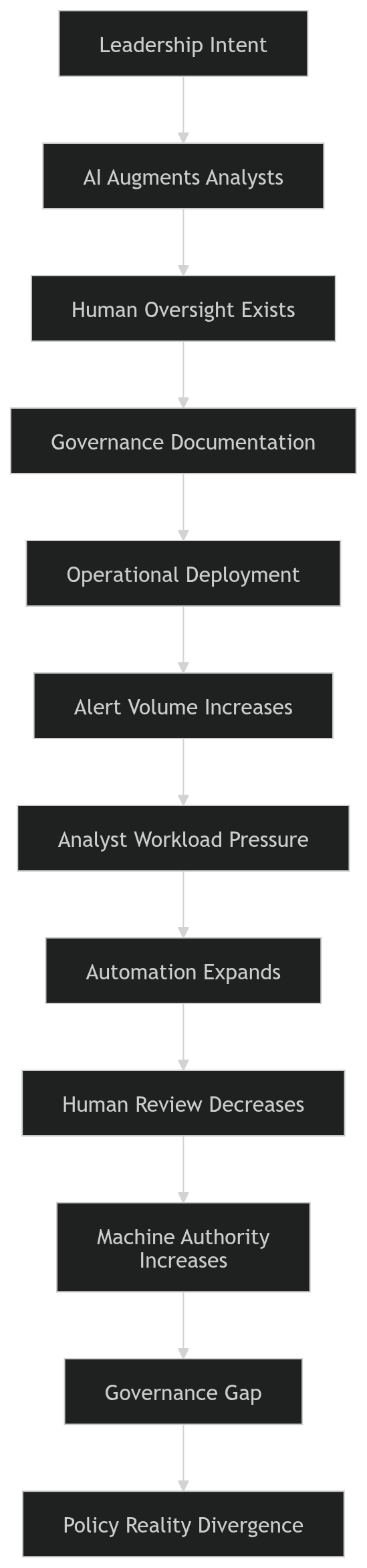
Caption: The governance gap does not appear because organizations ignore oversight. It emerges because operational pressure gradually changes how automation is used.
Part II — Operational Reality: How Humans Quietly Leave the Loop
Operational Reality
The easiest way to misunderstand AI adoption in security operations is to imagine that organizations suddenly hand control over to machines.
That is rarely what happens.
The reality is much more gradual.
A security operations center does not wake up one morning and decide:
Instead, trust shifts slowly."From today forward, the algorithm will determine what deserves human attention."
One alert at a time.
One workflow at a time.
One efficiency improvement at a time.
The organization does what organizations have always done under pressure:
It adapts.
A new AI-powered detection capability is introduced.
Initially, analysts review everything.
They compare recommendations against their own judgment.
They challenge false positives.
They investigate unusual outcomes.
The technology is new, so skepticism is high.
This is actually the healthiest stage of adoption.
The system has authority, but not trust.
Then something changes.
The AI performs well.
It reduces repetitive work.
It identifies patterns analysts previously missed.
It closes obvious noise.
Leadership sees improvement.
The metrics look better.
Alert queues decrease.
Response times improve.
The organization gains confidence.
And confidence is where the interesting part begins.
Because confidence is not the same as understanding.
Field Note
The most dangerous point in automation adoption is not when the technology fails.
It is when the technology succeeds often enough that people stop asking why.
Research Lens: Normalization of Deviance
Sociologist Diane Vaughan, examining the Challenger disaster, described how
organizations gradually accept small deviations from expected practice until
the abnormal becomes routine.
No single decision looks dangerous.
Each one slightly widens what counts as acceptable.
In the SOC, this is how an unreviewed alert category becomes normal.
Not through a decision to stop reviewing.
Through the quiet accumulation of not reviewing.
The Quiet Transfer of Authority
Authority rarely disappears through a formal decision.
It disappears through convenience.
A simple example:
A SOC receives thousands of authentication alerts every week.
Most are harmless.
The AI system learns patterns:
- Normal login locations
- Normal user behavior
- Expected access times
- Known device relationships
The model performs well.
Analysts begin trusting the scores.
Eventually, analysts stop reviewing low-risk events individually.
This is reasonable.
The entire purpose of automation was to reduce unnecessary work.
But now consider what happens six months later.
A legitimate attacker compromises an account.
The attacker behaves differently from normal users, but not differently enough.
The model sees a familiar pattern.
The confidence score remains low.
The alert receives minimal attention.
The system did not malfunction.
It performed exactly according to its learned assumptions.
The failure was not technical.
The failure was organizational.
The organization forgot that every automated decision represents a set of assumptions about reality.
Automation Bias
Human psychology has studied this phenomenon long before artificial intelligence entered cybersecurity.
Humans tend to place excessive trust in automated systems, especially when those systems have demonstrated reliability.
This tendency is known as automation bias.
The irony is that highly capable systems may create stronger automation bias than unreliable systems.
If a tool is obviously wrong, people challenge it.
If a tool is consistently helpful, people begin accepting it.
The transition from assistance to dependence happens quietly.
In aviation, automation bias has been studied extensively because pilots must manage the relationship between automated systems and human judgment.
The lesson is not that automation is bad.
Modern aviation would be impossible without automation.
The lesson is that automation changes the role of the human operator.
The operator becomes less of a manual controller and more of a supervisor of complex systems.
Cybersecurity is moving through the same transition.
The SOC Analyst's Changing Role
For decades, the SOC analyst role has been built around investigation.
An alert appears.
The analyst gathers evidence.
The analyst determines significance.
The analyst decides response.
AI changes this workflow.
The analyst increasingly becomes:
- A validator of machine recommendations
- An investigator of exceptions
- A reviewer of uncertain outcomes
- A supervisor of automated workflows
This is not necessarily a downgrade.
In many ways, it represents professional evolution.
A senior pilot does not manually control every mechanical process during flight.
A surgeon does not personally manufacture every medical instrument.
A network engineer does not manually inspect every packet.
Professionals move upward as systems become more capable.
The challenge is ensuring the organization understands that the role has changed.
A SOC analyst supervising AI requires different skills than an analyst manually triaging alerts.
They need:
- Critical evaluation
- Understanding of model limitations
- Ability to challenge recommendations
- Knowledge of organizational risk
- Strong investigative judgment
The danger appears when organizations deploy advanced systems but continue expecting humans to operate as if the systems do not exist.
When Efficiency Becomes the Enemy
Every security organization faces pressure.
Reduce costs.
Improve response times.
Handle more threats.
Do more with fewer resources.
These pressures are legitimate.
Security teams should absolutely seek efficiency.
The problem appears when efficiency metrics become disconnected from security outcomes.
Consider alert closure rate.
It is an attractive metric.
A SOC that closes 10,000 alerts per month appears productive.
But what does closure mean?
Does it mean:
- Correctly classified?
- Properly investigated?
- Risk appropriately accepted?
- Automatically suppressed?
- Ignored due to volume?
The metric alone does not answer the question.
An AI system can dramatically improve closure rates while quietly reducing detection quality.
The machine is not failing.
The organization is measuring the wrong thing.
Operational Reality
A security operation optimized only for speed will eventually discover that the fastest way to eliminate alerts is to eliminate the alerts.
The Organizational Science Behind the Problem
Cybersecurity leaders sometimes treat governance failures as unique technology problems.
They are not.
They are organizational problems wearing technology clothing.
Long before artificial intelligence, researchers studied how organizations create formal structures that differ from actual behavior.
One of the most relevant concepts is institutional decoupling.
Research Lens: Institutional Decoupling
In their influential 1977 paper, sociologists John Meyer and Brian Rowan described how organizations often separate formal structures from everyday operational practices.
Organizations create policies, procedures, and governance mechanisms because those structures provide legitimacy and demonstrate control.
However, actual work continues to evolve based on practical realities.
The documented process remains.
The operational process changes.
This concept appears frequently in technology environments.
A company may have:
- A documented access review process
- A documented change management process
- A documented incident response process
Yet experienced practitioners know that the real process often contains informal adaptations.
Not because people are careless.
Because environments are complex.
AI introduces another layer.
The formal governance document may state:
The operational reality may become:"Human analysts review AI-generated decisions."
Both statements can exist simultaneously."Humans review only unusual AI decisions."
The organization may genuinely believe it maintains oversight.
The operational system may already function differently.
Why AI Accelerates Decoupling
Traditional security tools usually require humans to interact directly with outcomes.
A firewall blocks traffic.
Someone notices.
A server fails.
Someone receives an alert.
A vulnerability scanner reports findings.
Someone reviews them.
AI systems create a different dynamic because they can operate continuously at a scale humans cannot match.
This creates distance.
The decision happens.
The action occurs.
The evidence exists somewhere.
But the human connection weakens.
The organization slowly moves from:
toward:"Humans make security decisions with machine assistance."
That is a very different operating model."Machines make security decisions with human exception handling."
The Accountability Problem
This leads to the central governance challenge.
Responsibility follows authority.
If humans have authority over decisions, humans are accountable.
If machines influence decisions, organizations must define how accountability works.
The uncomfortable question becomes:
The analyst?If an AI system closes a critical alert that contributes to a breach, who owns that decision?
The SOC manager?
The CISO?
The vendor?
The model developer?
The governance committee?
The answer cannot be discovered after an incident.
It must exist before one occurs.
The Human Factor Is Not the Weakness
There is an important distinction here.
The solution is not removing humans from the process.
Humans are not the problem.
Human judgment is actually the reason security operations exist.
Machines are excellent at:
- Processing volume
- Finding patterns
- Performing repetitive tasks
- Correlating information
Humans remain better at:
- Understanding intent
- Evaluating ambiguity
- Balancing competing risks
- Recognizing unusual circumstances
- Making ethical and organizational decisions
The future SOC is not human versus machine.
It is human judgment amplified by machine capability.
But amplification without control can increase the consequences of mistakes.
A faster mistake is still a mistake.
A scalable mistake becomes an incident.
The First Principle of Trustworthy AI Operations
Before an organization asks:
It should ask:"How much can we automate?"
That question changes the entire conversation."How much decision authority are we prepared to govern?"
Automation is not primarily a technology decision.
It is a risk decision.
The organization is not only choosing what AI can do.
It is choosing what consequences it is willing to accept when AI is wrong.
Transition: From Trust to Measurement
The answer is not distrust.
Security operations cannot function without trust.
Analysts already trust thousands of technologies every day.
The answer is measured trust.
A mature SOC does not say:
A mature SOC says:"We trust our AI system."
Trust without measurement is belief."We understand where our AI system is reliable, where it is limited, how often it fails, and what controls exist when it does."
Trust with measurement is governance.
The next challenge is building those measurements into the operational architecture.
That requires moving from understanding the problem to designing safeguards.
Part III — Detect → Decide → Defend: Engineering Trustworthy AI Safeguards
Building Trustworthy Automation
The security industry has spent years learning how to secure systems.
We understand the importance of defense in depth.
We understand layered controls.
We understand that no single safeguard is sufficient.
Yet when organizations introduce artificial intelligence into security operations, they often approach governance differently.
They search for one control.
One approval.
One checkbox.
One statement that says:
But trustworthy AI operations cannot be created through a single safeguard."A human remains responsible."
They require architecture.
The same principle applies to AI governance as it does to network security, identity management, and incident response:
Security is not a feature. It is a system of controls working together.
For AI-assisted security operations, that system should address three critical points in the lifecycle:
- What information enters the system?
- What decisions is the system allowed to make?
- How can those decisions be reconstructed and defended afterward?
These become the foundation of the framework:
Detect → Decide → Defend
The Framework Overview
                 AI-Assisted Security Operations

                         ┌──────────┐
                         │  Detect  │
                         └────┬─────┘
                              │
                 Is the information trustworthy?
                              │
                              ▼

                         ┌──────────┐
                         │  Decide  │
                         └────┬─────┘
                              │
                 Is the authority appropriate?
                              │
                              ▼

                         ┌──────────┐
                         │ Defend   │
                         └────┬─────┘
                              │
                 Can the decision be explained?
                              │
                              ▼

                    Measured Organizational Trust
Each stage answers a different governance question.
Stage One — Detect
Trust Begins Before the Model
Most discussions about AI security focus on the model.
How accurate is it?
How advanced is it?
How large is it?
What algorithms does it use?
Those questions matter.
But they begin too late.
Before a model makes a decision, it receives information.
And every AI system is limited by the quality of the information it receives.
A highly capable model operating on unreliable data is still unreliable.
Architect's Notebook
A model does not understand your environment.
It understands the information your environment provides.
Consider a simple SOC example.
An AI detection platform identifies unusual behavior from endpoint telemetry.
The model has been trained and validated.
Performance metrics look strong.
However, one endpoint logging source silently stopped reporting.
The model does not know this.
It simply sees fewer signals.
The absence of information becomes part of its reasoning.
The result is not a broken system.
The result is a confidently incorrect system.
Data Quality Is a Security Control
Security teams traditionally think about data availability.
Is the log source online?
Is the sensor reporting?
Is the collector working?
AI operations require a broader perspective.
The question is not only:
The question is:"Are we receiving data?"
Important considerations include:"Can we trust the data we are receiving?"
Data Freshness
Threat intelligence expires.
Attack patterns change.
Indicators become outdated.
A malicious domain from three years ago may be irrelevant today.
A behavioral model trained on yesterday's environment may struggle with tomorrow's environment.
Data Completeness
Missing telemetry creates blind spots.
An AI system cannot compensate for information it never receives.
A model may appear less accurate when the real problem is incomplete visibility.
Data Consistency
Security environments change constantly.
New applications appear.
New users join.
Cloud services expand.
Remote work changes behavior.
A model trained on historical patterns must understand when those patterns are no longer representative.
Data Drift: The Silent Failure Mode
One of the most important concepts in AI governance is drift, Traditional security controls often fail visibly, AI systems can fail quietly because the environment changes, There are several types of drift:
Concept Drift
The relationship between behavior and meaning changes.
Example:
A login pattern that was historically suspicious becomes normal because an organization changes its remote access model.
Data Drift
The underlying data changes.
Example:
A company migrates from on-premises infrastructure to cloud platforms,
The telemetry environment changes significantly.
Threat Drift
Attackers adapt, a technique that worked yesterday may evolve tomorrow.
Security AI must operate against an adversary who actively changes behavior.
A mature SOC treats drift monitoring as a security requirement, Not an optional machine learning activity.
Operational Reality: The False Comfort of Dashboards
One of the easiest mistakes organizations make is trusting availability dashboards.
A dashboard shows:
- Model online
- Data pipeline healthy
- Detection service active
Everything appears normal.
But operational health is not the same as security effectiveness.
A system can be available and wrong.
A system can be functioning and outdated.
A system can be operationally healthy while strategically failing.
This is one of the fundamental differences between traditional infrastructure monitoring and AI governance.
Detect Safeguards
A mature AI-assisted SOC should establish controls around inputs.
Examples include:
| Control | Purpose |
|---|---|
| Telemetry freshness monitoring | Identify outdated information |
| Data quality scoring | Measure reliability |
| Source ownership | Establish accountability |
| Model input validation | Prevent unexpected conditions |
| Drift monitoring | Detect environmental change |
| Threat intelligence lifecycle management | Prevent stale context |
If the answer is unknown, every downstream decision becomes questionable.Can we trust what the AI system is seeing?
Stage Two — Decide
Defining the Boundary of Machine Authority
The most important AI governance decision is not technical, It is organizational.
The question is not:
Modern systems can perform many actions."Can this AI system perform this action?"
The better question is:
Capability and authority are different concepts, A system may be technically capable of isolating an endpoint, That does not automatically mean the organization should permit autonomous isolation."Should this AI system be allowed to perform this action without human approval?"
Risk-Tiered Autonomy
A mature SOC should classify AI decisions according to consequence.
Not convenience.
A common mistake is allowing automation based on confidence scores alone.
For example:
That sounds impressive."The model is 98% confident."
But confidence is not impact.
A 98% confidence score for closing a low-risk phishing alert is very different from a 98% confidence score for disabling a production server account.
The consequence matters.
A practical model:
| Risk Level | Example Action | AI Authority |
|---|---|---|
| Low | Categorizing known benign events | Autonomous |
| Moderate | Prioritizing investigations | Recommendation |
| High | Blocking accounts or devices | Human approval |
| Critical | Business-impacting actions | Human controlled |
The principle remains:
Automation authority should decrease as consequence increases.
The Problem With "Human Approval"
At first glance, requiring human approval appears to solve the problem.
But approval can become another checkbox.
Consider:
The next questions are:"A manager approved the automated response."
- Did they understand the recommendation?
- Did they review evidence?
- Did they have enough time?
- Was approval meaningful or procedural?
Approval without understanding is not governance.
It is authorization theater.
Human Oversight Must Be Designed
Effective human oversight requires:
Context
The reviewer must understand why the system reached its conclusion.
Time
The reviewer must have realistic capacity.
A human cannot meaningfully review thousands of decisions per hour.
Authority
The reviewer must be able to stop or modify the system.
Accountability
The organization must know who owns the decision boundary.
Research Lens: Human Factors Engineering
Human factors research teaches an important lesson:
People adapt to the systems around them.
If a system consistently rewards accepting automation, acceptance becomes normal behavior.
If a system makes challenging automation difficult, challenges decrease.
Therefore, organizations cannot simply instruct humans:
They must design workflows that make meaningful oversight possible."Stay vigilant."
A governance process that depends entirely on individual discipline will eventually fail.
Stage Three — Defend
Accountability After the Decision
The final stage addresses the question organizations often ignore:
What happens afterward?
An AI decision may appear reasonable today.
Six months later, an investigator may need to understand what happened.
A regulator, an auditor, a customer, a board member may ask.
The organization must reconstruct the decision.
The Reconstruction Test
A mature AI security operation should be able to answer:
- What decision was made?
- When was it made?
- Which model version made it?
- What data influenced it?
- What confidence level existed?
- What policy allowed the action?
- Who owned the decision boundary?
If these questions cannot be answered, accountability has already failed.
Field Note
Logs are not only for troubleshooting systems.
In AI-enabled operations, logs become evidence of organizational judgment.
Accountability Engineering
Traditional logging focuses on technical events:
- User login
- File access
- Network connection
- System change
AI governance requires additional context:
- Model identity
- Model version
- Prompt or instruction context
- Decision confidence
- Input sources
- Policy evaluation
- Human review status
The organization is no longer only recording what happened.
It is recording why a decision happened.
The Difference Between Explanation and Accountability
AI explainability is often discussed as if it solves governance.
It does not.
A model explaining:
is useful."These indicators contributed to a high-risk score."
But accountability requires more.
It requires understanding:
- Was the model authorized to make this decision?
- Was the decision within approved boundaries?
- Was the organization monitoring performance?
- Were known limitations documented?
Explanation tells us why.
Governance tells us whether it should have happened.
The Three Principles Together
Detect asks:
Decide asks:"Can we trust the information?"
Defend asks:"Can we trust the authority?"
Together they create a governance foundation."Can we trust the accountability?"
Without Detect, AI decisions may be based on unreliable information.
Without Decide, AI authority expands without control.
Without Defend, organizations cannot explain or improve outcomes.
The Next Challenge
The framework establishes control points.
But control points require measurement.
A SOC cannot simply claim:
It must demonstrate it."Our AI is governed."
That requires moving beyond operational metrics like speed and volume.
It requires measuring machine judgment itself.
The next question becomes:
How do we measure whether AI decisions are actually improving security?
Part IV — Measuring Machine Judgment: Metrics, Validation, The Future SOC, and The Last Thought

Measuring What Actually Matters
One of the oldest mistakes in technology management is measuring what is easy instead of measuring what matters.
Security operations has not escaped this problem.
Organizations measure:
- Number of alerts processed
- Mean time to detect (MTTD)
- Mean time to respond (MTTR)
- Automation percentage
- Analyst productivity
- Queue reduction
These metrics are valuable.
They tell a story.
But they do not tell the whole story.
When AI enters the SOC, a new category of measurement becomes necessary:
How often is the machine correct?
Not:
Not:How often did the machine make a decision?
But:How quickly did the machine close something?
This distinction is the foundation of trustworthy automation.How frequently did the machine's judgment align with reality?
The Difference Between Speed and Quality
Consider two SOCs.
The first SOC reports:
The second SOC reports:"Our AI platform reduced alert volume by 80%."
The first SOC sounds more efficient."Our AI platform reduced alert volume by 65%, while maintaining a measured false-negative rate below our approved risk threshold."
The second SOC demonstrates governance.
The difference is not technology.
The difference is measurement maturity.
A machine can become extremely efficient at reducing workload.
That does not automatically mean it improves security.
An AI system optimized around the wrong objective will often achieve the objective perfectly.
This is one of the most important principles in AI governance:
Optimization without alignment creates measurable success in the wrong direction.
The Missing Metric: AI Decision Quality
Security organizations should begin treating AI decisions as operational events that require quality measurement.
A practical starting point is measuring:
AI-Assisted Detection Quality
Questions:
- How many AI-generated classifications were correct?
- How many important events were incorrectly dismissed?
- How often did analysts overturn AI recommendations?
- Which categories produce the most disagreement?
AI-Autonomous Decision Quality
For actions performed without human approval:
- How often were decisions later reversed?
- How many incidents originated from automated decisions?
- Were errors concentrated in specific environments?
- Did performance degrade over time?
Human Override Analysis
A particularly valuable measurement is disagreement.
Many organizations treat human overrides as failures.
That is the wrong interpretation.
Disagreement is data.
If experienced analysts repeatedly override AI recommendations in specific scenarios, the organization has learned something important.
Either:
- The model needs improvement.
- The decision boundary needs adjustment.
- The human process is inconsistent.
- The risk classification is wrong.
The disagreement itself becomes a learning mechanism.
Research Lens: Treat AI Evaluation Like an Experiment
Security teams often evaluate AI tools informally.
Someone asks:
A demonstration looks promising."Does it work?"
A pilot performs well.
The organization proceeds.
This approach is understandable.
Security teams move quickly.
However, mature AI governance requires a more scientific mindset.
The question is not whether the system works in general.
The question is:
That is a very different question.Under what conditions does the system work, and under what conditions does it fail?
Sampling AI Decisions
Organizations do not need humans reviewing every AI decision.
That defeats the purpose of automation.
Instead, they need disciplined sampling.
A mature approach includes:
- Random sampling rather than convenience sampling
- Defined review criteria
- Consistent analyst evaluation
- Documented findings
- Trend analysis over time
For example:
An organization may review a statistically meaningful sample of AI-closed alerts every month.
Reviewers determine:
- Was closure correct?
- Was evidence sufficient?
- Would a human have reached the same conclusion?
- Did the AI miss important context?
Over time, the organization builds evidence.
Not assumptions.
Research Lens
"We trust our AI system" is a belief statement.
"We reviewed a representative sample of autonomous decisions over twelve months and measured error patterns" is an evidence statement.
Governance depends on the second.
Confidence Is Not Accuracy
One of the most common misconceptions in AI adoption is confusing confidence with correctness.
A model can be highly confident and wrong.
This is especially dangerous in security because attackers actively attempt to operate outside normal patterns.
The environment is adversarial.
The system is not operating in a stable laboratory.
It is operating against an intelligent opponent.
A mature SOC therefore asks:
but also:"How confident is the model?"
The second question is often more valuable."When has this model historically been wrong?"
A Practical Scenario: The Alert That Disappeared
Consider a fictional but realistic scenario.
A financial organization deploys an AI-assisted XDR platform.
The platform analyzes:
- Endpoint behavior
- Authentication activity
- Network telemetry
- Threat intelligence
During the first months, performance is excellent.
Alert volume decreases significantly.
Leadership celebrates.
The SOC reports improved efficiency.
Several months later, attackers compromise a privileged account.
The attackers use legitimate tools.
Their behavior resembles administrative activity.
The AI system assigns moderate risk.
The alert is automatically deprioritized.
No immediate investigation occurs.
The attackers maintain access for weeks.
Eventually, a separate detection identifies suspicious activity.
During the investigation, the team discovers that earlier AI decisions contained warning signs.
The model was not broken.
The data was not missing.
The system simply optimized based on previous patterns.
The organization never measured whether similar decisions had historically failed.
The problem was not the existence of AI.
The problem was unmanaged trust.
Leadership Reporting: Moving Beyond Green Dashboards
Executives do not need every technical detail.
But they need the right questions.
A mature CISO dashboard should not only show:
- Automation rate
- Response improvement
- Cost reduction
It should also show:
- AI decision accuracy
- Human disagreement rate
- False-negative trends
- Model drift indicators
- High-risk autonomous actions
- Governance exceptions
The conversation changes.
Instead of:
Leadership asks:"How much work did AI remove?"
That is a much more mature conversation."What decisions did AI make, and how confident are we in those decisions?"
The Future SOC
The future SOC will almost certainly be more autonomous than today's SOC.
That is not speculation.
The operational pressure makes it inevitable.
Security teams face:
- Increasing attack volume
- Expanding infrastructure
- Cloud complexity
- Identity challenges
- Limited skilled personnel
Automation will continue.
The question is not whether machines will receive more authority.
The question is whether organizations will mature enough to govern that authority.
The Future Analyst
The security analyst of the future will likely spend less time performing repetitive investigation.
Instead, they will spend more time:
- Validating machine reasoning
- Investigating unusual cases
- Designing detection logic
- Reviewing automation boundaries
- Managing risk decisions
The profession will change.
This is not the disappearance of expertise.
It is the evolution of expertise.
A future analyst may not be measured by how many alerts they personally close.
They may be measured by how effectively they supervise a security decision ecosystem.
The Future CISO
The CISO role will also evolve.
Historically, security leadership focused heavily on:
- Technology selection
- Vulnerability reduction
- Incident response
- Compliance
AI introduces another responsibility:
Governance of automated judgment.
The CISO must understand:
- What decisions are automated?
- Where are boundaries defined?
- How is performance measured?
- What happens when assumptions fail?
The question will no longer be:
Almost every organization will."Do we have AI?"
The question will become:
"Can we prove our AI is operating within acceptable risk?"
Implementation Roadmap
Organizations beginning this journey do not need to redesign everything immediately.
A practical roadmap:
Step One: Inventory Autonomous Decisions
Do not start with tools.
Start with decisions.
Identify:
- What does AI recommend?
- What does AI execute?
- What does AI suppress?
- What does AI prioritize?
The goal is visibility.
Step Two: Establish Decision Boundaries
Classify decisions based on impact.
Define:
- What AI can do independently
- What requires approval
- What is prohibited
Document ownership.
Step Three: Create Measurement Processes
Establish:
- Sampling methodology
- Review criteria
- Accuracy tracking
- Override analysis
- Drift monitoring
Trust should have evidence behind it.
Step Four: Integrate Governance Into Operations
AI governance should not exist separately from security operations.
It belongs inside:
- Change management
- Detection engineering
- Incident response
- Risk management
- Security architecture
Step Five: Report Quality Alongside Speed
The SOC should report both:
How fast did we respond?
And:
How often was our judgment correct?
Both matter.
Questions Worth Asking
Before increasing AI autonomy, security leaders should ask:
- Which decisions are already automated today?
- Would we know if those decisions became less accurate?
- What percentage of AI decisions receive meaningful review?
- Can we reconstruct an AI decision six months later?
- Are we measuring security improvement or only workload reduction?
- Have we defined actions AI should never perform?
- Who owns the risk when automation fails?
These questions are uncomfortable.
That is exactly why they are valuable.
The Last Thought
Artificial intelligence is often described as a technology transformation.
That description is incomplete.
The deeper transformation is organizational.
AI changes how decisions are made.
It changes who participates in those decisions.
It changes how quickly decisions occur.
And eventually, it changes what organizations consider acceptable levels of uncertainty.
The greatest mistake would be believing that AI removes human responsibility.
It does the opposite.
The more authority we give machines, the more intentional humans must become.
The future SOC will not be defined by organizations that automate the most.
It will be defined by organizations that understand what they are automating, why they are automating it, and what happens when the machine is wrong.
A machine can process more information than any analyst.
It can identify patterns faster than any human team.
It can operate continuously without fatigue.
But it cannot accept responsibility.
That remains a human decision.
And perhaps that is the most important safeguard of all.

0 Comments
Leave a comment